

What Peptide Purity Percentage Means in Research
A label stating 99% purity can look like a simple quality verdict. In laboratory sourcing, it is better understood as one defined analytical result. Knowing what peptide purity percentage means helps researchers compare materials appropriately, interpret Certificates of Analysis, and avoid treating a single number as a complete description of a peptide batch.
For research-use-only peptides, purity matters because even small amounts of related compounds or process residues may affect an in-vitro experiment. The practical question is not only whether a purity value is high. It is also how that value was measured, what it represents, and whether the batch documentation supports the intended research application.
What peptide purity percentage means
Peptide purity percentage generally describes the proportion of the primary peptide component detected within a sample by a specified analytical method. A reported result of greater than 99% purity typically means that the principal chromatographic peak accounted for more than 99% of the measured signal under that method's conditions.
This distinction is essential. Purity is not automatically a direct measure of biological activity, sequence confirmation, sterility, endotoxin level, moisture content, or net peptide mass. Those are separate attributes that may require separate tests.
For example, a 99% HPLC purity result indicates that the target component predominated in the chromatogram. It does not, by itself, establish that the peptide is suitable for every experimental design. Researchers should match the documentation and testing scope to the demands of their protocol.
Why peptide impurities occur
Peptides are assembled through stepwise chemical synthesis. At each stage, incomplete coupling, side reactions, protecting-group removal, oxidation, deamidation, or cleavage-related changes can create closely related byproducts. Purification is intended to isolate the desired material from these components, but no purification process is completely without limits.
The remaining fraction in a high-purity material may contain trace levels of deletion sequences, truncated peptides, oxidized forms, isomers, synthesis reagents, counterion-related material, or residual processing components. The exact profile depends on the peptide sequence, length, amino acid composition, manufacturing process, handling, and storage conditions.
A purity specification should therefore be read as a statement about the dominant component, not as a claim that the remaining percentage is one known, uniform impurity. A 1% difference between two lots also does not necessarily mean one is meaningfully better for every study. The nature of the minor components and the sensitivity of the assay both matter.
HPLC purity: the number most often reported
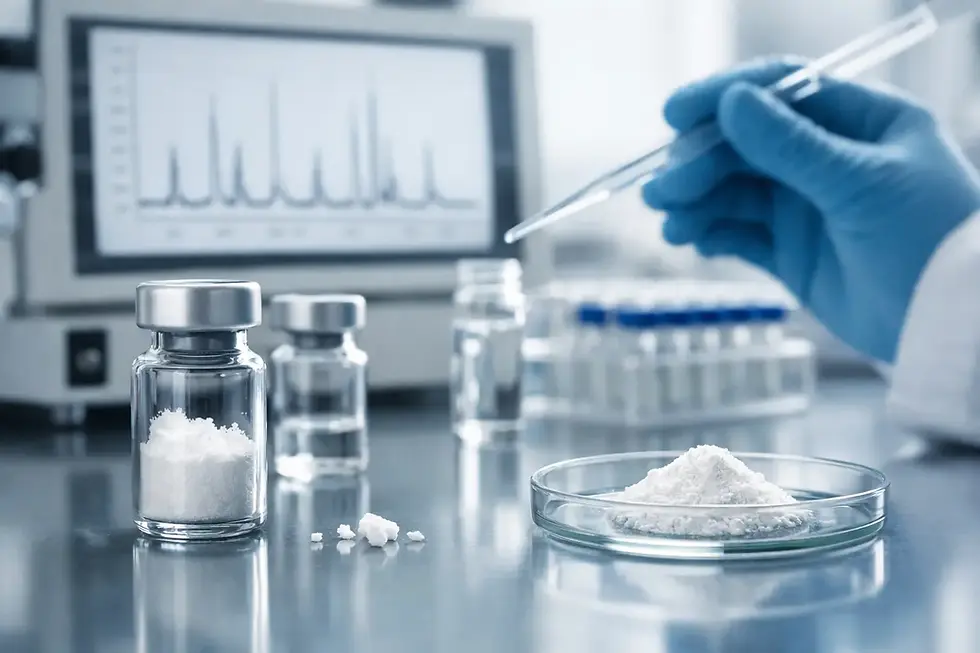
High-performance liquid chromatography, commonly abbreviated as HPLC, is widely used to assess peptide purity. The method separates sample components based on their interaction with the chromatographic system. As compounds elute, the instrument records peaks. The relative area of the primary peak is commonly used to calculate the reported purity percentage.
A chromatogram with one dominant peak and very small secondary peaks may support a high purity value. However, HPLC results are method-dependent. Column chemistry, mobile phase, gradient, detection wavelength, sample preparation, and integration settings can affect separation and peak-area calculation.
That does not make HPLC unreliable. It means the result should be interpreted within its analytical context. A credible Certificate of Analysis should identify the testing method or clearly state the purity analysis used. Lot-specific documentation provides more useful information than a broad, unsupported purity claim printed without batch traceability.
HPLC also has limits. Two compounds that co-elute under a given method may appear as one peak, while a differently optimized method may separate them. This is why responsible quality review considers purity alongside orthogonal testing rather than asking one chromatogram to answer every analytical question.
Purity and identity are related, but not interchangeable
Purity answers, “How much of the measured sample appears to be the primary component?” Identity answers, “Is that primary component the intended peptide?” Both questions must be addressed.
Mass spectrometry is commonly used to support identity by confirming that the observed molecular mass aligns with the expected mass of the target peptide. For a researcher evaluating a lyophilized peptide powder, an HPLC result and mass spectrometry result together offer a more informative quality picture than either result alone.
Even then, researchers should recognize the boundaries of the documentation. A matching mass does not necessarily distinguish every structural variant, and an HPLC purity result does not independently confirm sequence. The appropriate testing package depends on the scientific risk of the work. Exploratory educational work and a tightly controlled comparative assay may reasonably require different levels of characterization.
What a high purity percentage does and does not tell you
A high purity percentage can provide confidence that the intended peptide is the major detected component. This is particularly relevant when reproducibility, signal interpretation, and comparison across experiments depend on limiting the influence of closely related peptide impurities.
It does not establish concentration after reconstitution. Lyophilized material can contain moisture, salts, counterions, or other non-peptide mass that affects mass-based calculations. It also does not replace appropriate handling, storage, solution preparation, or experimental controls.
Nor does purity establish suitability for human or animal use. Research-use-only peptide materials are supplied for qualified in-vitro laboratory and educational applications. They are not intended for human or animal consumption, diagnosis, treatment, cure, or disease prevention. A quality result should never be used to blur that regulatory and safety boundary.
How to review a peptide Certificate of Analysis
A Certificate of Analysis, or COA, connects a quality claim to a specific batch. Before incorporating a material into a research workflow, review whether the document identifies the product, lot or batch number, analytical results, and testing approach. The lot number on the COA should correspond to the lot received.
For peptide materials, start with the reported purity result and whether HPLC is identified. Then review the identity information, such as expected and observed mass when mass spectrometry is included. Product form, quantity, storage guidance, and date-related documentation can also be useful for laboratory records.
Transparency matters as much as the headline number. A supplier that makes lot-level COAs accessible allows researchers to assess materials before committing them to an experiment. This supports internal documentation, troubleshooting, and better continuity when reordering a compound or planning a multi-stage study.
Be careful with vague language such as “pharmaceutical grade” or “high quality” when it is not paired with batch-specific evidence. These phrases do not explain the analytical method, the lot tested, or the actual result. A clearly reported greater-than-99% purity result, tied to a COA and supported by identity data, is far more actionable.
Choosing purity for the research question
There is no universal purity threshold that fits every peptide experiment. A high-purity material is generally preferable when minor components could complicate an analytical readout, create background effects, or interfere with a mechanism-focused in-vitro study. It may also be especially valuable when comparing results across lots or working with low-concentration systems.
At the same time, purity should not be evaluated in isolation. A poorly documented 99% claim can be less useful than a well-documented result with transparent method information and reliable lot traceability. Researchers should also consider the compound’s identity data, packaging integrity, storage conditions, and supplier consistency.
For multi-compound research stacks, documentation becomes even more important. Each constituent should have its own traceable quality profile. A stack is not analytically defined merely because its individual components have familiar names or because the combined format is convenient.
A more useful way to read the label
Rather than treating purity as a pass-or-fail badge, treat it as a decision tool. Ask what analytical method produced the number, whether identity was verified, what batch the document covers, and whether the stated testing aligns with the sensitivity of the research plan.
That approach keeps peptide sourcing grounded in evidence. A high purity percentage is meaningful when it is transparent, lot-specific, and interpreted alongside the rest of the analytical record. For qualified researchers, that is the standard worth carrying from the product label to the laboratory notebook.


Comments